
Paying your suppliers late
is costing you more than you know.
Most business owners worry about getting paid on time. Very few worry about paying on time. But late supplier payments have real, measurable costs — and missing early payment discounts is one of the most expensive mistakes in business finance.
What late supplier payments actually cost you
The cost of paying suppliers late is not just a penalty fee on an invoice. It shows up in four different places — and most business owners only ever see one of them.
Missed early payment discounts
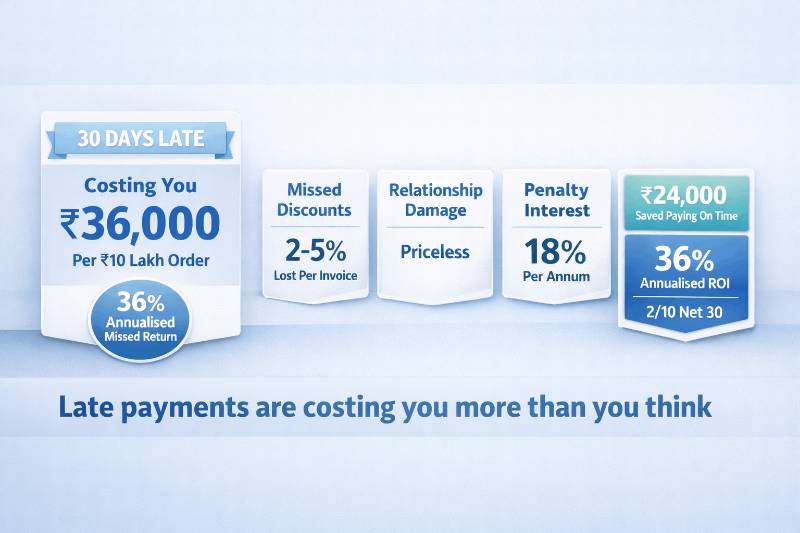
Suppliers offering 2/10 Net 30 give you a 2% discount for paying 20 days early. Miss it and you lose that saving on every single invoice.
2–5% lost per invoicePenalty interest charges
Many supplier contracts include a late payment clause — typically 1.5% per month or 18% per year — that kicks in automatically after the due date.
18% per annum typicalSupplier relationship damage
Suppliers who are paid late prioritise other customers for stock, capacity, and best pricing. The cost of being deprioritised is invisible but very real.
Higher prices over timeCredit score and terms impact
Consistent late payments affect your business credit profile — leading to tighter payment terms, smaller credit limits, and higher deposit requirements from suppliers.
Long-term financial costThe total cost of paying suppliers late — when you add missed discounts, penalty interest, relationship premium, and tighter credit terms — typically runs to 2 to 3 percent of your total payables value per year. On ₹50 lakh in annual supplier payments, that is ₹1 to 1.5 lakh quietly disappearing every year.
The most overlooked risk-free return in business
Here is the number that surprises every business owner who hears it for the first time. When a supplier offers you terms of 2/10 Net 30 — meaning a 2% discount if you pay within 10 days instead of 30 — the annualised return on that early payment is approximately 36%.
Think about that for a moment. You are being offered a guaranteed, risk-free, 36% annualised return — just by paying an invoice 20 days earlier than you were planning to. There is no investment available anywhere that offers that return without risk. And most businesses are ignoring it entirely.
The maths simply explained: You save 2% by paying 20 days early. There are approximately 18 such 20-day periods in a year. 2% multiplied by 18 equals 36%. That is your annualised return from capturing every 2/10 Net 30 discount available to you.
How much is late payment costing your business?
Ready-to-use payment reminder messages for your team
The most common reason businesses pay late is not lack of cash — it is a slow approval process. These templates help your team act fast enough to capture discounts and avoid penalties.
Internal alert — send this to your accounts team when an invoice arrives
Early payment discount available: 2% if paid by [Date — 10 days from invoice].
Saving: ₹[Amount × 2%]. Please approve and process before [Date].
Supplier communication — when you need more time
Thank you for the invoice dated [Date] for ₹[Amount].
We are processing payment and expect to transfer by [Date — within terms].
Please confirm your bank details remain unchanged.
Best regards,
[Your name]
Escalation — overdue invoice from your supplier
We note that invoice [Number] dated [Date] for ₹[Amount] is now overdue.
We are arranging payment immediately and will transfer by [Date].
We apologise for the delay and value our ongoing relationship.
Best regards,
[Your name]
6 ways to start paying on time — and capturing every discount
- Set up auto-approval for invoices under a threshold. Most late payments happen because invoices sit waiting for manual approval. Any invoice under ₹25,000 should auto-approve and queue for payment within 5 days of receipt — no human bottleneck.
- Create a twice-weekly payment run schedule. Instead of paying invoices randomly, run payments every Tuesday and Friday. This simple change captures most discount windows and eliminates most late payments without any extra effort.
- Track your discount capture rate monthly. Divide the discounts you actually claimed by the discounts that were available. Most businesses start below 30%. Getting to 80% capture rate is worth more than any other cash flow improvement available to you.
- Negotiate better terms if cash flow is tight. If you genuinely cannot pay within the discount window, talk to your supplier. Many will offer extended terms — Net 45 or Net 60 — rather than lose a good customer. Ask before you default.
- Use UPI for instant supplier payments. When a discount window is closing, a UPI transfer settles in 2 seconds — not 1 to 3 days like a NEFT. For time-sensitive payments, UPI is the fastest and cheapest option available.
- Review your top 10 suppliers annually. Check your payment history with each one. Are you consistently late with certain suppliers? That is damaging a relationship that is probably worth more than whatever cash you are holding onto.
The simple truth: The cost of paying suppliers late is real, measurable, and entirely avoidable. Two changes — an auto-approval workflow for small invoices and a twice-weekly payment run — will capture most of the available savings within 30 days.
Use these keywords at 3% density in your blog
How to hit 3% density: In a 1,500-word blog, use the focus keyword "cost of paying suppliers late" 4 to 5 times — in the title, first paragraph, one subheading, body text, and conclusion. Use secondary keywords naturally throughout — never force them.
BANNER IMAGE ALT TEXT & SEO
Short alt text: Blog banner showing a 30-day late payment costing ₹36,000 on the left, four cost and saving cards in the centre, and the headline Late payments are costing you more than you think at the bottom.
Full SEO alt text: Illustrated blog banner on a light grey background with a red top accent bar. The left white card with red header shows a 30-day late payment costing ₹36,000 on a ₹10 lakh annual order, with a 36% annualised missed return label. Four smaller cards show missed early payment discounts of 2 to 5 percent, supplier relationship damage labelled priceless, penalty interest at 18 percent per annum, and on the green-bordered cards the savings from paying on time at ₹24,000 and a 36% annualised ROI from 2/10 Net 30 terms. The headline reads Late payments are costing you more than you think.
Pinterest caption: Paying your suppliers late by just 30 days could be costing you ₹36,000 per ₹10 lakh in orders — and a 36% risk-free return you are missing every year. Here is the number every business owner needs to see. Save this.
Image filename: cost-of-paying-suppliers-late-india-2026.png
Want more simple business finance guides?
No jargon — just the numbers that matter for your business.
