
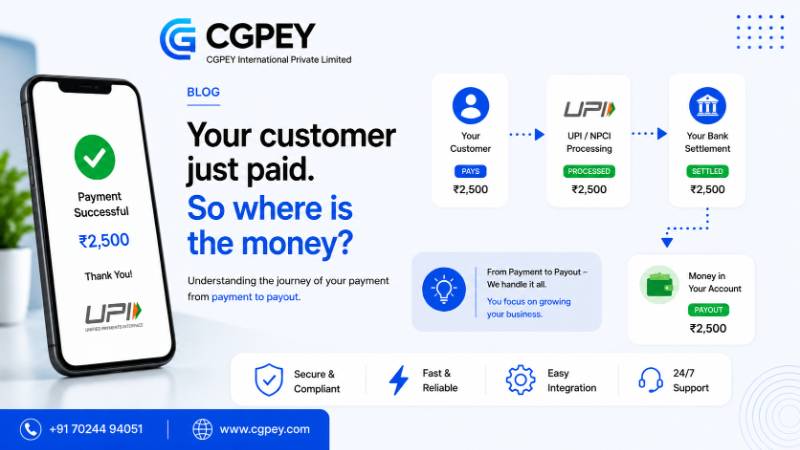
Why your money does not arrive the moment your customer pays
Most business owners assume that when a customer pays, the money moves directly from their account to yours. It feels that way — the POS beeps, the screen says approved, the customer walks away happy. But the money has not moved yet. Not really.
What actually happened is that a very fast series of messages flew between five different institutions — each checking, authorising, and recording the transaction. The actual movement of money follows later, in batches, through a settlement process that can take anywhere from two seconds to three business days depending on how your customer paid.
Think of it this way: the payment approval is like receiving a signed cheque. The settlement is like the cheque actually clearing. Most businesses confuse the two — and that confusion is what leads to cash flow surprises.
Your money's journey — step by step
Customer initiates payment
Customer taps card, scans QR, or enters payment details. Their device or POS terminal sends an encrypted payment request containing the amount, merchant ID, and card details to the payment gateway.
Time elapsed: 0 secondsPayment gateway receives and forwards
Your payment gateway — the software behind your checkout or POS — receives the encrypted request, checks it for basic errors, and forwards it securely to the payment processor. This happens in milliseconds.
Time elapsed: under 1 secondPayment processor routes to card network
The processor — a company like Razorpay, PayU, or Stripe — takes the request and routes it to the correct card network. Visa goes to Visa's network. Mastercard goes to Mastercard's. The network then contacts the customer's bank.
Time elapsed: 1–2 secondsCustomer's bank approves or declines
The customer's bank — called the issuing bank — checks whether the customer has enough funds or credit, whether the transaction looks fraudulent, and whether the card is valid. It sends back an authorisation code — or a decline.
Time elapsed: 2–5 secondsApproval travels back to you
The approval code travels back through the card network, to the processor, to the gateway, and finally to your POS or checkout screen. The whole round trip — steps 1 through 5 — takes about 2 to 5 seconds. But the money still has not moved.
Time elapsed: 2–5 seconds totalSettlement — the money actually moves
At the end of the business day your processor batches all approved transactions and submits them for settlement. The card network facilitates the actual transfer of funds from the customer's bank to your acquiring bank — the bank that holds your merchant account.
Time elapsed: end of business dayMoney lands in your account — minus fees
Your acquiring bank receives the funds and deposits them into your merchant account, minus all processing fees. Depending on your provider, this takes 1 to 3 business days after settlement. The amount you receive is the sale price minus interchange, network, and processor fees.
Time elapsed: 1–3 business days after saleHow settlement time changes by payment type
Not all payment methods follow the same journey. The type of payment your customer uses directly affects how quickly the money reaches you.
UPI
Payment and settlement happen simultaneously. Money moves directly between banks in real time with no batching.
Settles in 2 secondsDebit card
Authorisation is instant but settlement is batched. Funds move at end of day and arrive in 1 to 2 business days.
Settles in 1–2 daysCredit card
Same process as debit but the customer's bank extends credit. Settlement takes 1 to 3 business days typically.
Settles in 1–3 daysBank transfer (NEFT)
Processed in hourly batches during banking hours. Arrives same day if sent before cutoff, next day otherwise.
Settles same or next dayIMPS / RTGS
Real-time gross settlement. Each transaction settles individually and immediately — no batching at all.
Settles in minutesCash
Immediate — but requires physical handling, counting, and banking. Risk of theft and human error is higher.
Immediate — with caveatsQuestions every business owner asks about payment timing
5 ways to get your money faster as a business
- Encourage UPI payments wherever possible. UPI settles in 2 seconds, 24 hours a day, 7 days a week. It is the fastest settlement method available and costs your business almost nothing in fees.
- Ask your processor about next-day settlement. Most payment providers offer this option for a small additional fee. For high-volume businesses or those with tight cash flow, the cost is usually worth the benefit.
- Batch your card transactions early in the day. Some providers settle transactions submitted before a certain cutoff time on the same business day. Check your provider's batch cutoff and aim to close your terminal before it.
- Build your payment history to shorten holds. New merchant accounts often have longer settlement holds as a fraud precaution. Processing consistently over 3 to 6 months typically shortens these holds significantly.
- Track pending versus settled amounts separately. Know exactly how much is authorised but not yet settled at any given time. This gives you an accurate real-time picture of your cash position and prevents overspending against money that has not arrived yet.
The cash flow trap: Many businesses spend against approved payments before they actually settle. If a payment reverses or a chargeback comes in after you have already spent that money, you are in a deficit. Always distinguish between what is approved and what is actually in your account.
Approval is a promise. Settlement is the money.
The payment system is designed to be invisible — and most of the time, it works well enough that you never need to think about it. But when cash flow is tight, when a refund is taking forever, or when a payment seems to have disappeared, understanding this journey is the difference between panicking and knowing exactly what to check.
The short version: approval happens in seconds, settlement happens in hours to days, and the money arrives in your account minus fees at the end of that chain. Encourage UPI where you can, ask your provider about faster settlement options, and always track your actual cleared balance — not just your approved transactions.
One action today: Log into your payment dashboard and find where it shows "pending settlement" versus "cleared funds." That number — the difference between the two — is money your customers have paid that has not reached you yet. Now you know exactly where it is.
Want more simple guides like this one?
Written for business owners — no jargon, just the things that actually matter.
