




Let’s break it down in a simple, real-world way.
What is a Payment?
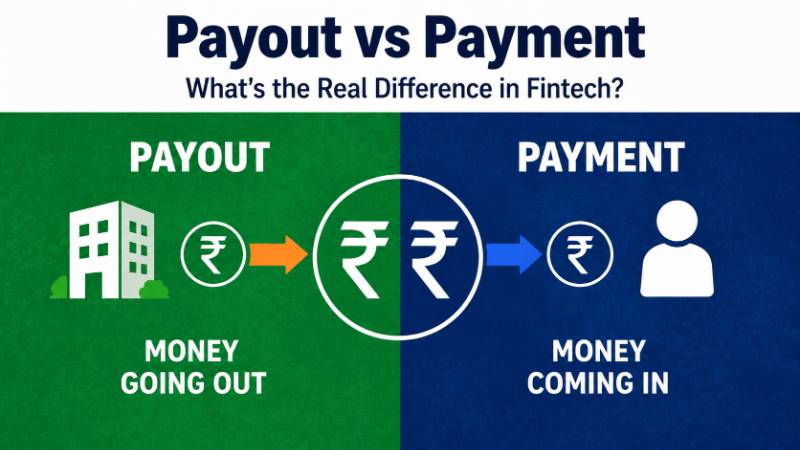
A payment is when money comes into your business.
It happens when a customer pays you for a product or service. This is the “incoming” side of a transaction.
Simple examples:
- A customer buys a product on your website → you receive money
- A user pays a subscription fee → your platform collects money
- Someone books a service → payment is made to your business
In fintech systems, payments are usually handled through:
- Payment gateways
- UPI apps
- Debit/credit cards
- Net banking
Key idea:
👉 Payment = Money Coming In
What is a Payout?
A payout is when money goes out from your business to someone else.
It is used to distribute funds to employees, vendors, freelancers, or users.
Simple examples:
- You pay salary to employees
- You send earnings to sellers on your platform
- You pay freelancers after project completion
- You issue refunds or cashback
Key idea:
👉 Payout = Money Going Out
The Core Difference (In One Line)
👉 Payment collects money. Payout distributes money.
Side-by-Side Comparison
| Feature | Payment | Payout |
|---|---|---|
| Direction | Incoming money | Outgoing money |
| Who initiates | Customer | Business/platform |
| Purpose | Collect funds | Distribute funds |
| Example | Buying a product | Paying a seller |
| Use case | Sales, subscriptions | Salaries, commissions, refunds |
Real-Life Flow: How Both Work Together
To understand better, let’s look at a real-world scenario involving an ecommerce platform like Amazon or Flipkart.
Step-by-step flow:
- A customer places an order → Payment happens
- The platform receives the money
- The product is delivered
- The platform deducts its commission
- Remaining amount is sent to the seller → Payout happens
So, both payment and payout are part of the same transaction cycle—but they happen at different stages.
Why This Difference Matters in Fintech
Understanding payment vs payout is important because fintech systems are built around these two functions.
For businesses:
- Payments help generate revenue
- Payouts help manage expenses and operations
For fintech apps:
- Payment systems ensure smooth money collection
- Payout systems ensure timely distribution
If either side fails, the entire system breaks.
Role of Fintech Platforms
Modern fintech platforms like Razorpay and Cashfree Payments provide both payment and payout solutions in one place.
This allows businesses to:
- Accept payments from customers
- Automatically send payouts to vendors or users
- Track the entire money flow in a single dashboard
This integration is especially useful for startups and online platforms.
Common Use Cases
Payment Use Cases:
- Ecommerce checkout
- Subscription billing
- Online ticket booking
- Recharge and bill payments
Payout Use Cases:
- Freelancer payments
- Affiliate commissions
- Seller settlements
- Salary transfers
- Cashback and rewards
Common Mistake Beginners Make
Many beginners think payment = payout, but that can lead to confusion while setting up systems.
For example:
- If you only set up a payment gateway, you can receive money but not send it
- To send money, you need a payout system or API
So, both are required for a complete financial workflow.
Final Thoughts
In fintech, payments and payouts are two sides of the same coin. One brings money into your business, while the other sends it out.
- Payments power your revenue
- Payouts power your operations
A successful digital business needs both working smoothly together.
Once you understand this difference, it becomes much easier to design systems, choose the right tools, and scale your business efficiently.