
What is an API —
and why every fintech business needs one in 2026
From UPI payments to KYC verification to fraud detection — every fintech product runs on APIs. Here is a complete plain-language guide to what APIs are, how they work, and why they are the most important infrastructure decision in fintech today.
What is an API — explained without the jargon
API stands for Application Programming Interface. That sounds complicated. It is not. Think of an API as a waiter in a restaurant.
You — the customer — sit at the table. The kitchen — the bank, the payment network, the KYC provider — has everything you need. But you cannot walk into the kitchen yourself. The waiter takes your order, carries it to the kitchen, and brings back exactly what you asked for. That waiter is the API.
In fintech terms: your app wants to process a UPI payment. Your app cannot directly talk to the bank's core system. An API sits in between — it takes your payment request, passes it to the right system, waits for the response, and delivers the result back to your app in a structured format — usually in under two seconds.
One sentence definition: An API is a standardised way for two software systems to talk to each other — securely, reliably, and at scale — without either system needing to know how the other one works internally.
How an API call actually works — step by step
Your app sends a request
Your fintech app sends a structured request to the API endpoint — for example, "process a ₹5,000 UPI payment from this VPA to this account." The request includes all the required data in a standard format — usually JSON.
API verifies who you are
Before processing anything, the API checks your credentials — API key, OAuth token, or digital signature — to confirm you are an authorised caller. Unauthorised requests are rejected immediately. This is how APIs stay secure.
The backend does its work
The API passes your request to the underlying system — the bank, the payment network, the KYC database. That system processes it and prepares a response. For a UPI payment, this involves communicating with NPCI's UPI infrastructure in real time.
API returns the result to your app
The API sends back a structured response — success or failure, along with all relevant data like transaction ID, timestamp, and status. Your app reads this response and updates its interface accordingly. The whole round trip typically takes 1 to 3 seconds.
What a fintech API call actually looks like
Here is a simplified example of what your app sends when initiating a UPI payment via a payment gateway API — and what comes back:
// What your app SENDS to the API
{
  "method":   "UPI",
  "amount":   5000,
  "currency": "INR",
  "vpa":      "customer@upi",
  "order_id": "ORD2026051234"
}

// What the API SENDS BACK
{
  "status":    "SUCCESS",
  "txn_id":    "TXN2026051234",
  "amount":    5000,
  "timestamp": "2026-05-25T11:04:45Z",
  "message":   "Payment processed successfully"
}
No code knowledge needed to understand this: You are sending a request with the payment details. The API sends back a confirmation. Your app reads "SUCCESS" and shows the customer a green tick. That is the entire flow.
The most important APIs in the fintech industry today
Payment APIs
UPI, card processing, NEFT, RTGS — these APIs power every money movement in fintech. Razorpay, Cashfree, and PayU expose these as simple REST calls your app can make in milliseconds.
KYC & Identity APIs
Aadhaar verification, PAN validation, video KYC, face match — APIs from providers like Digio, CKYC Registry, and UIDAI let fintech apps verify users in seconds without manual document checking.
Open Banking APIs
Account Aggregator APIs let fintech apps fetch a user's bank statements, transactions, and financial data — with the user's consent — to enable loan eligibility checks, credit scoring, and financial planning.
Fraud Detection APIs
Real-time risk scoring APIs analyse transaction patterns, device fingerprints, and behavioural data to flag suspicious activity before a transaction completes — protecting both businesses and customers.
Credit & Lending APIs
Bureau APIs from CIBIL, Experian, and CRIF High Mark let lenders pull credit scores and repayment histories in real time — reducing loan processing from days to minutes.
FX & Currency APIs
Real-time exchange rate APIs power international money transfers, multi-currency wallets, and cross-border payment apps — fetching live rates from interbank markets and applying them instantly.
Which fintech businesses use APIs the most
Payment gateways & wallets
Razorpay, PayU, PhonePe — their entire products are essentially APIs that other businesses connect to. Every checkout you have ever completed was an API call.
Digital lenders & NBFCs
KYC API + Bureau API + Bank statement API = loan approved in 10 minutes. APIs have collapsed the loan processing timeline from weeks to minutes.
Insurtech companies
Policy issuance, claim processing, and premium calculation — all driven by APIs that connect insurers with hospitals, vehicle registries, and customer databases in real time.
Wealthtech & trading apps
Zerodha, Groww, Upstox — market data APIs, order execution APIs, and portfolio APIs power every trade your customers make from their phone.
The common thread: Every fintech business that has scaled rapidly in the last five years did it by building on top of APIs — not by rebuilding infrastructure from scratch. APIs compress years of development into weeks of integration.
Why your fintech business cannot scale without APIs in 2026
- Speed to market. Building a payment system from scratch takes years and costs crores. Integrating a payment API takes days and costs a fraction. APIs let you focus on your product — not on rebuilding infrastructure that already exists.
- Compliance without the complexity. KYC, AML, data localisation — APIs from regulated providers handle these requirements on your behalf. You inherit their compliance rather than building your own from zero.
- Scale without friction. An API that handles 100 transactions today can handle 1 crore transactions tomorrow — without any change on your side. The API provider manages the infrastructure scaling.
- Real-time everything. Credit scores, fraud signals, payment status, FX rates — all available in real time through APIs. Without them, your product would be working with stale data and manual processes.
- Ecosystem connectivity. Open Banking APIs let your fintech product connect to any bank, any broker, any insurer — with user consent. This connectivity is impossible without APIs and is the foundation of every embedded finance product.
The bottom line: In 2026, an API is not a technical detail — it is a business strategy. The fintech companies winning right now are not the ones with the most engineers. They are the ones that chose the right APIs, integrated them well, and built great products on top. The infrastructure already exists. The question is whether you are using it.
BANNER IMAGE ALT TEXT & SEO
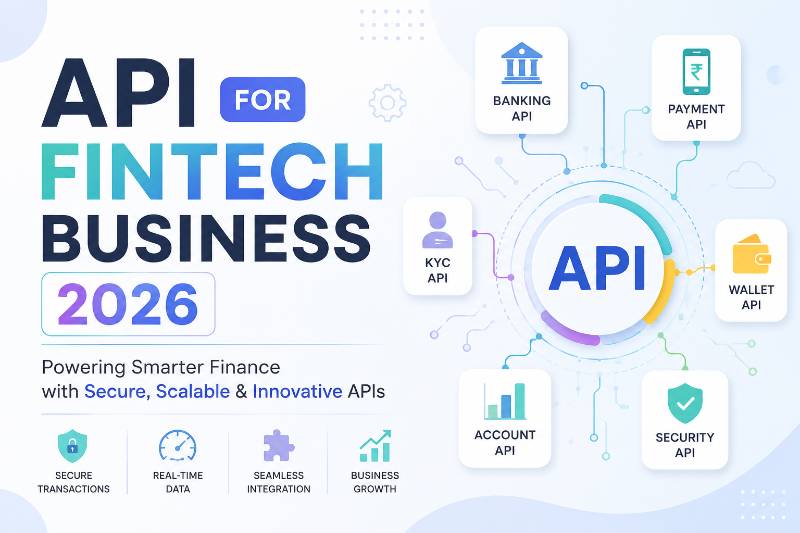
Short alt text: Blog banner for what is an API in fintech 2026 — left white card shows large API headline with three API type boxes, right dark card shows a real UPI payment API code example with success response in green.
Full SEO alt text: Light grey blog banner with blue top and bottom accent bars. Left white card with blue header shows a category pill reading Fintech API Guide 2026, the large bold headline API in blue, subtitle and why every fintech business needs one, and three type boxes showing REST most common, UPI payments API, and OAuth security API. Right dark charcoal card shows a code editor window with red yellow and green dots, a UPI payment JSON request with blue keys and yellow string values, the amount field showing 5000 in red, and a green success response block reading Payment of Rs.5,000 processed successfully with transaction ID and response time. White footer reads cgpey.com What Is an API and Why Every Fintech Business Needs One 2026 Guide.
Image filename: what-is-api-fintech-business-guide-2026.png
Pinterest caption: APIs are the backbone of every fintech product — UPI payments, KYC verification, credit scoring, fraud detection. Here is the complete plain-language guide to what APIs are, how they work in fintech, and why your business cannot scale without one in 2026. Save this.
Explore more fintech guides for your business
No jargon — just the technology and strategy that actually matters.
