
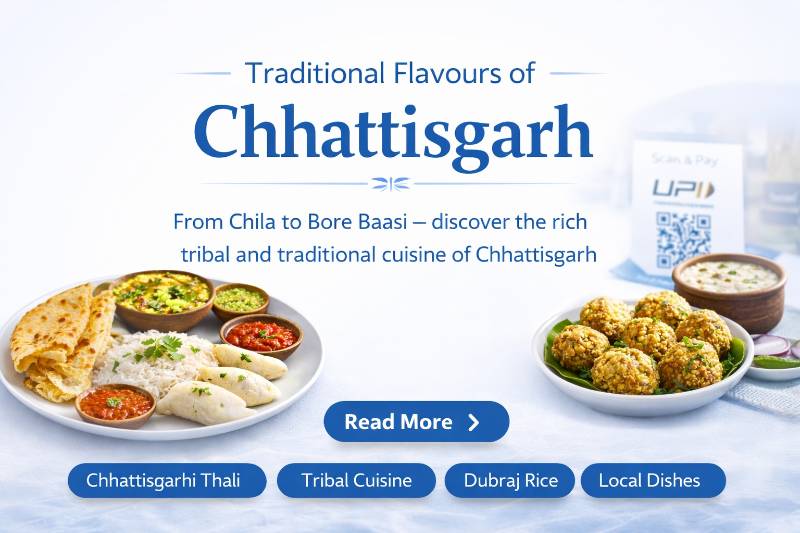
Introduction: The Food Culture of Chhattisgarh
Tucked away in the heartland of India, the state of Chhattisgarh is often celebrated for its dense forests, ancient temples, and vibrant tribal culture. But there is another dimension of this remarkable state that deserves equal recognition — its extraordinarily rich, wholesome, and flavourful food and cuisine. The traditional food of Chhattisgarh is a direct reflection of its land, its people, and its centuries-old way of life.
Known as the "rice bowl of India", Chhattisgarh produces over 60% of its agricultural output in the form of rice. It is therefore no surprise that rice forms the very backbone of Chhattisgarhi cuisine — appearing in almost every meal, from breakfast to dinner, in steamed, fermented, ground, and roasted forms. The food here is earthy, nutritious, mildly spiced, and deeply satisfying, carrying the soul of the forest and the generosity of the land in every bite.
The cuisine of Chhattisgarh is also deeply influenced by its tribal communities — the Gond, Baiga, Halba, Muria, and many others — who have their own distinctive cooking traditions, ingredients, and food rituals passed down through generations. Eating in Chhattisgarh is not merely about sustenance; it is a cultural and spiritual experience tied to festivals, harvests, and community bonds.
Rice — The Soul of Chhattisgarhi Cuisine
To truly understand Chhattisgarhi food, one must first understand the centrality of rice. The state cultivates over a hundred varieties of indigenous rice, many of which have been grown for thousands of years. Varieties like Dubraj, Vishnu Bhog, Karma Bhog, and Jeeraphool are prized not only for their taste and aroma but also for their medicinal and nutritional properties.
Dubraj rice in particular is the pride of Chhattisgarh — a short-grain, aromatic variety with a distinctive fragrance and soft texture, often described as the basmati of Chhattisgarh. It has earned a Geographical Indication (GI) tag, cementing its identity as a unique and irreplaceable product of this land.
Rice is consumed in numerous forms: as plain steamed rice, as rice porridge (maand), as fermented rice water, as flat rice cakes, and as a base for countless snacks and sweets. Even the water left after boiling rice — called Maand — is consumed as a health drink, rich in starch and minerals.
Famous Traditional Dishes of Chhattisgarh
The traditional dishes of Chhattisgarh are simple, nutritious, and made from locally sourced ingredients. Here are the most famous and beloved dishes that every food lover must try:
Chila
Thin, crispy rice-flour crepes served with chutney or sabji. The most popular breakfast dish in Chhattisgarh — light, tasty and nutritious.
Fara
Steamed rice-flour dumplings stuffed with spiced chana dal filling. A wholesome snack or light meal, loved across the state.
Bafauri
Steamed chana dal fritters — a healthy, oil-free snack packed with protein and flavour. A staple in rural Chhattisgarh homes.
Muthiya
Twisted steamed dumplings made from rice or wheat flour, often served with curries or chutneys. A versatile and filling dish.
Aamat
A tangy, spicy tribal curry made with mixed forest vegetables and bamboo shoots — a signature dish of the Bastar region.
Bore Baasi
Overnight soaked cooked rice eaten with onion, green chilli and salt. A beloved summer breakfast that keeps the body cool all day.
Pitthaa
Steamed rice dumplings filled with sweetened coconut or sesame — a festive delicacy enjoyed especially during Teej and other festivals.
Angakar Roti
Thick rice-flour flatbread cooked directly over glowing coals, giving it a smoky, earthy flavour unique to rural Chhattisgarh.
Chila — The Breakfast King
Chila is arguably the most iconic breakfast food of Chhattisgarh. Made from a thin batter of soaked and ground rice, poured onto a hot griddle and cooked into paper-thin crepes, Chila is eaten with tomato chutney, garlic chutney, or a simple sabji. It is gluten-free, light on the stomach, and deeply satisfying. In almost every household and roadside eatery across Raipur, Bilaspur, and Jagdalpur, Chila is served fresh in the mornings, drawing long queues of eager locals.
Fara — The Steamed Soul Food
Fara is the Chhattisgarhi answer to dumplings. Rice flour is kneaded into a smooth dough, shaped into small cylinders, stuffed with a filling of spiced chana dal (split chickpeas), and then steamed to perfection. The result is a soft, satisfying snack with a lovely contrast between the rice outer casing and the spiced filling inside. Fara is eaten with mustard oil, green chilli, and coriander chutney. It is a beloved Sunday morning dish in most Chhattisgarhi homes.
Bafauri — Healthy and Delicious
Bafauri is a steamed fritter made from soaked and coarsely ground chana dal, mixed with spices, ginger, and green chilli, then shaped into small balls and steamed rather than fried. This makes Bafauri one of the healthiest traditional snacks in Chhattisgarh — high in protein, low in fat, and full of flavour. It is served with a sharp green chutney and is particularly popular during the monsoon season.
Bore Baasi — The Summer Superfood
Perhaps the most unique dish in Chhattisgarh's culinary repertoire, Bore Baasi is simply cooked rice that has been soaked in water overnight and consumed the next morning. It sounds simple, but this humble dish is a cultural institution. The overnight fermentation process gives the rice a slightly tangy taste and transforms it into a probiotic-rich, cooling food that is perfect for the scorching Chhattisgarhi summers. It is eaten with raw onion, green chilli, salt, and sometimes a dollop of ghee or buttermilk.
The Chhattisgarhi Thali
No discussion of Chhattisgarh cuisine is complete without talking about the legendary Chhattisgarhi Thali — a complete meal served on a large plate (thali) that brings together the full range of flavours and textures that this cuisine has to offer. A traditional Chhattisgarhi Thali is a feast for the senses and one of the best ways to experience the breadth of local food culture in a single sitting.
| Item | Description |
|---|---|
| Steamed Rice (Dubraj/Vishnu Bhog) | Fragrant local variety, the centrepiece of every thali |
| Dal (Arhar/Chana) | Simple lentil curry tempered with mustard and garlic |
| Kadhi | Tangy yoghurt-based curry with fried chana dal fritters |
| Badi-Bhaji | Sun-dried lentil nuggets cooked with leafy greens |
| Angakar Roti | Thick rice-flour flatbread cooked over coal embers |
| Chutney | Tomato, coriander, or raw mango chutney |
| Papad & Achaar | Crispy lentil wafers and local pickle |
| Muthiya / Fara | Steamed dumplings as a side or starter |
| Kheer / Gud (Jaggery) | Rice kheer or raw jaggery as dessert |
A well-served Chhattisgarhi Thali is abundant, vegetarian-forward, and almost always served with a warm smile. Many restaurants in Raipur, Bilaspur, and Jagdalpur now serve dedicated Chhattisgarhi Thalis to tourists and locals alike, making it easy to experience the full culinary heritage of the state in one meal.
Tribal & Bastar Food Culture
The tribal food culture of Chhattisgarh, especially in the Bastar region, is one of the most fascinating and unique in all of India. The indigenous communities of Bastar — including the Gond, Muria, Halba, and Dhruva tribes — have developed their own extraordinary culinary traditions over thousands of years, deeply intertwined with the forests, rivers, and seasons of the region.
Aamat is the most celebrated tribal dish of Bastar — a pungent, spicy curry made from a medley of wild forest vegetables, including bamboo shoots, raw jackfruit, colocasia, and various forest greens, cooked with dried fish or simply vegetarian. The use of local souring agents, forest herbs, and minimal oil gives Aamat a deeply complex and unique flavour that cannot be replicated outside its native environment.
Tribal communities in Bastar also make extensive use of mahua flowers — a tree that holds great cultural and culinary significance. Mahua flowers are used to make sweets, fermented drinks, and even a traditional liquor that is deeply embedded in tribal festival traditions. The forest also provides a range of edible greens, mushrooms, tubers, and fruits that form an important part of tribal diets and are rarely found on urban menus.
🌿 Forest Ingredients Unique to Bastar Cuisine
Bamboo shoots (baans ki kali) — used in curries, pickles, and fermented preparations
Mahua flowers — used in sweets, drinks, and traditional brewing
Tendu leaves — culturally significant; also used to wrap food for cooking
Wild mushrooms — sautéed with local spices; a monsoon delicacy
Char seeds — pressed for edible oil used in tribal cooking
Sweets & Desserts of Chhattisgarh
The sweets and desserts of Chhattisgarh are characterised by their use of rice, jaggery, sesame, and coconut — ingredients that reflect the agricultural abundance of the state. These desserts are not overly sugary but carry a deep, satisfying sweetness that comes from natural ingredients and traditional preparation methods.
Pitthaa — The Festive Dumpling
Pitthaa is a steamed rice dumpling filled with a sweet mixture of coconut and jaggery or sesame and jaggery. It is one of the most beloved festive sweets in Chhattisgarh, made especially during Teej, Hartalika, and Pola festivals. The outer layer of rice flour is soft and delicate, while the sweet filling inside provides a burst of flavour. Pitthaa is also made in a savoury version with spiced dal as filling.
Dehrori
Dehrori is a traditional Chhattisgarhi sweet made from fermented rice batter, shaped into small balls, deep-fried to a golden crisp, and then soaked in sugar syrup. The slight tang from fermentation combined with the sweetness of the syrup makes Dehrori a uniquely addictive dessert. It is particularly popular during the Diwali and Chhath Puja seasons.
Kusli
Kusli is a half-moon shaped deep-fried sweet pastry filled with a mixture of coconut, sesame, and jaggery. Similar in appearance to a gujiya, Kusli has its own distinct local flavour and is a popular sweet during the winter festival season.
Street Food of Raipur & Beyond
The street food scene of Chhattisgarh — especially in cities like Raipur, Bilaspur, and Durg — is vibrant, affordable, and deeply satisfying. The streets come alive in the evenings with the sizzle of griddles and the aroma of freshly made snacks drawing hungry crowds.
Chila stalls are ubiquitous across every city and town, serving piping hot crepes with chutneys. Sabudana Khichdi (tapioca pearls tempered with peanuts and green chilli) is a popular fasting food and street snack. Samosas and Kachori with local variations of spicing are sold at virtually every corner. Mungodi ki Sabji — crispy moong dal fritters cooked in a spiced gravy — is a popular street meal eaten with rice or roti.
In Raipur, the Pandri Market and Shastri Market areas are famous food streets where one can find an excellent variety of local street food, from Chila and Fara to chaat, jalebi, and seasonal snacks. Evenings in Raipur's food lanes are a wonderful sensory experience for any food traveller.
Traditional Drinks & Beverages
Chhattisgarh has a rich tradition of fermented and herbal beverages that reflect the ingenuity of its people in using local resources.
Maand (rice starch water) is the most widely consumed traditional drink — a byproduct of boiling rice that is rich in electrolytes and soothing to the digestive system. It is consumed warm or at room temperature and is considered highly beneficial during illness and summer heat.
Sulfi is a traditional mildly fermented drink extracted from the Sulfi palm tree, popular among the tribal communities of Bastar. It is slightly sweet, effervescent, and mildly alcoholic — consumed fresh on the day of extraction. Mahua liquor, distilled from the flowers of the Mahua tree, is the most culturally significant tribal beverage of Chhattisgarh and holds deep ritual importance in tribal festivals and ceremonies.
On the non-alcoholic side, raw mango panna (a cooling summer drink made from raw mango, jaggery, and spices) and chaas (buttermilk) with local spices are extremely popular during the hot summer months.
Where to Eat Authentic Chhattisgarhi Food
Finding authentic Chhattisgarhi food is easiest in the state's own cities, towns, and villages. Here are the best places to experience the real flavours of Chhattisgarh:
- Raipur — The state capital has the widest variety of restaurants serving traditional Chhattisgarhi Thali and street food. Areas like Pandri Market, GE Road, and Telibandha are food hotspots.
- Jagdalpur (Bastar) — The best place to try authentic tribal food including Aamat, bamboo shoot curry, and Mahua-based preparations. Local eateries near the tribal market are excellent.
- Bilaspur — Famous for its street food culture, especially Chila, Samosas, and local sweets like Dehrori.
- Dhamtari & Rajnandgaon — Smaller towns with deeply traditional home-style cooking; the best way to experience local food here is through community meals during local festivals.
- Rural villages during festivals — The most authentic Chhattisgarhi food is always found in homes and community kitchens during local festivals like Hareli, Pola, and Bastar Dussehra.
Tips for Food Travellers in Chhattisgarh
- Always try Bore Baasi for breakfast at least once — it is the most authentic morning food experience in rural Chhattisgarh.
- Visit a local weekly tribal market (Haat Bazaar) in Bastar to see and taste ingredients and prepared foods not found anywhere else.
- The Chhattisgarhi Thali is best enjoyed at lunch, which is the main meal of the day in local tradition.
- Most traditional Chhattisgarhi food is vegetarian and gluten-free (rice-based), making it ideal for those with dietary restrictions.
- During the monsoon season (July–September), look for seasonal specialties like wild mushroom dishes and fresh bamboo shoot curries in Bastar.
- Carry a light stomach when visiting food streets — portions are generous and the urge to try everything is overwhelming!
- Pair any Chhattisgarhi meal with a glass of cold chaas (buttermilk) for the most refreshing local experience.
Conclusion
The food and cuisine of Chhattisgarh is a treasure trove that remains largely undiscovered by the wider world, even as it nourishes millions of people with its wholesome goodness every single day. From the crispy morning Chila to the hearty Chhattisgarhi Thali at lunch, from the smoky Angakar Roti to the sweet, steamed Pitthaa at festivals, every dish in Chhattisgarh tells a story — of the land, the seasons, the rivers, the forests, and the people who have lived in harmony with nature for centuries.
As Chhattisgarh tourism continues to grow, its food culture is beginning to receive the recognition it deserves. Travellers who come to see the waterfalls of Bastar, the temples of Rajim, or the tribal art of Kondagaon now have an equally compelling reason to visit — the opportunity to eat some of the most honest, nourishing, and culturally rich food in the country.
Whether you are a food enthusiast, a curious traveller, or someone with roots in the region, the traditional food of Chhattisgarh is an experience that will leave you deeply satisfied — and eagerly planning your next meal.
(Chhattisgarh's food — simple, pure, and made with heart.)— A traditional Chhattisgarhi saying
