
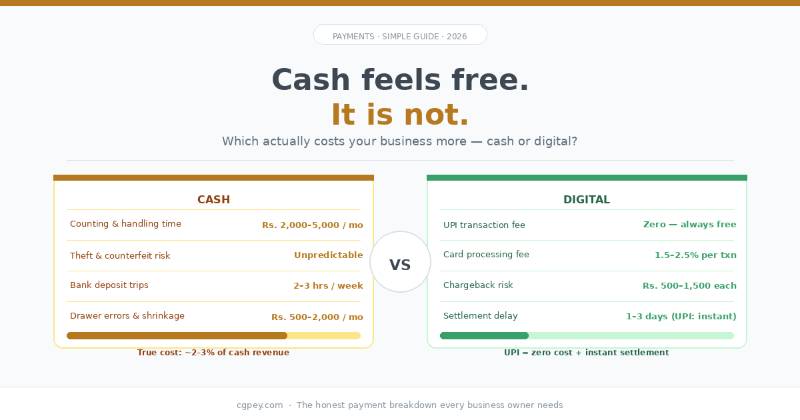
Cash feels free.
It is not.
Most business owners think accepting cash costs nothing. Digital payments have fees you can see. But cash has costs you cannot see — and they add up faster than you think. Here is the honest comparison.
Why cash is not actually free
When a customer pays by card or UPI, the fee is right there on your dashboard — 1.8%, ₹3.50 per transaction, whatever it is. You can see it. You resent it. You think about switching providers.
When a customer pays cash, you see nothing deducted. It feels free. But that feeling is an illusion. Cash has very real costs — they are just invisible because nobody sends you an invoice for them.
The time your staff spends counting the drawer at the end of the day. The trip to the bank every Tuesday. The notes that turn out to be fake. The ₹500 that goes missing and nobody knows how. The insurance you pay to cover theft. None of these show up as a payment fee — but all of them are costs of accepting cash.
The honest number: When businesses properly account for all cash handling costs — staff time, banking fees, counterfeit losses, theft, and errors — the true cost of accepting cash is typically 1.5 to 3 percent of cash revenue. That is the same as most card fees — but nobody talks about it.
Every cost — cash vs digital — laid out honestly
How much is cash actually costing your business?
The honest verdict — when cash wins and when digital wins
Very small transactions
For amounts under ₹50 to ₹100, the card fee percentage makes digital impractical. Cash is still the right call here.
No internet coverage
In areas with unreliable connectivity, cash is the only option. Always keep cash as a backup even if digital is your primary method.
Transactions above ₹200
For most amounts above ₹200, the savings on handling, counting, and banking time outweigh the digital transaction fee.
High-volume businesses
The more transactions you process, the more cash handling costs multiply. Digital scales cleanly — cash costs compound.
Any UPI payment
UPI has zero fees and instant settlement. There is no scenario where UPI costs more than cash for amounts above ₹100.
Retail and food businesses
Keep both options available. Encourage UPI with a small sign. Let customers choose — but know your actual costs for each.
The UPI exception: The entire cash-vs-digital debate changes when UPI is in the picture. UPI costs your business nothing in transaction fees, settles instantly, and records itself automatically. For any business in India, UPI should be the default — and cash the backup.
5 ways to reduce your total payment costs starting today
- Put a UPI QR code at every payment point. It costs nothing to accept, settles instantly, and eliminates all cash handling costs for that transaction. Make it the first option your customers see.
- Track your real cash handling cost this month. Log every hour spent counting, banking, and reconciling. Multiply by your hourly labour cost. The number will surprise you — and give you data to make better decisions.
- Set a minimum card payment threshold. Cards are expensive for very small amounts. A ₹200 minimum for card payments is legal and widely accepted — it steers small purchases to UPI or cash where appropriate.
- Negotiate your card processing fee. If you process more than ₹1 to 2 lakh per month by card, call your provider and ask for a lower rate. Most will reduce it — they would rather cut your margin than lose the account.
- Count your shrinkage honestly. If your end-of-day cash count is regularly short — even by small amounts — start recording it. That number is a direct cost of accepting cash, and seeing it monthly will change how you feel about digital fees.
The bottom line: Cash is not free and digital is not expensive. They both have real costs — one is just visible and the other is invisible. The business owners who know both numbers make better decisions. Now you know both.
BANNER IMAGE ALT TEXT & SEO
Alt text (short): Split blog banner — amber left half shows four hidden cash costs, green right half shows four digital payment costs, VS badge in the centre. Headline reads Cash vs digital payments — which actually costs your business more.
Alt text (full SEO): Illustrated split blog banner divided vertically into two halves. The left amber half is titled Cash with a dark amber top bar and lists four hidden cost rows — counting and handling time at ₹2,000 to ₹5,000 per month, theft and counterfeit risk labelled unpredictable, bank deposit trips at 2 to 3 hours per week, and cash drawer errors at ₹500 to ₹2,000 per month. The right green half is titled Digital with a green top bar and lists UPI transaction fee at zero, card processing fee at 1.5 to 2.5 percent, chargeback risk at ₹500 to ₹1,500 each, and settlement delay at 1 to 3 days with UPI instant. A white VS badge sits in the centre between the two panels. The headline at the bottom reads Cash vs digital payments — which actually costs your business more in 2026.
Image description for CMS: Split-panel banner. Left amber panel lists hidden cash costs. Right green panel lists visible digital payment costs. White VS circle in centre. Dark headline and subtitle on white strip at bottom.
Pinterest caption: Everyone thinks cash is free. It is not. Counting time, theft risk, fake notes, and banking trips cost Indian businesses 2 to 3 percent of cash revenue — the same as a card fee. But UPI costs nothing. Here is the real comparison. Save this.
Want more simple money guides for your business?
No jargon — just the real numbers every business owner needs to know.
