
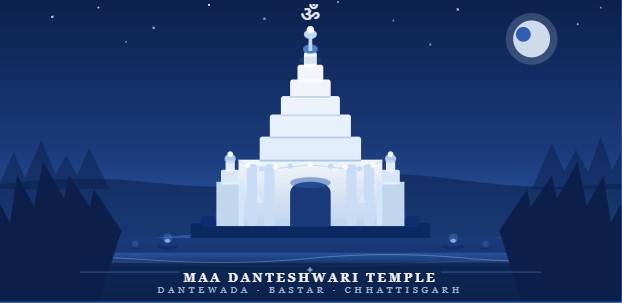
Introduction: The Sacred Heart of Chhattisgarh
Nestled deep in the lush forests of the Bastar region, the Danteshwari Temple in Dantewada, Chhattisgarh stands as one of the most revered and spiritually powerful shrines in the entire country. Dedicated to Maa Danteshwari — the fierce and benevolent mother goddess — this ancient temple is considered one of the 52 Shakti Peeths of India, making it a site of extraordinary religious significance for millions of Hindu devotees across the nation.
For anyone searching for famous temples in Chhattisgarh, the Danteshwari Temple is undoubtedly the crown jewel. It is not merely a place of worship; it is a living testament to centuries of tribal culture, devotion, architectural brilliance, and spiritual energy that defines the soul of Chhattisgarh. Every year, hundreds of thousands of pilgrims and tourists visit this sacred temple to seek the blessings of the goddess and experience the unique cultural atmosphere of the Bastar region.
Historical Background of Danteshwari Temple
The Danteshwari Temple Chhattisgarh has a history that stretches back over 600 years. According to historical records and local legends, the temple was originally constructed by the rulers of the Chalukya dynasty of Bastar, who made Danteshwari Mata their kuldevi (clan goddess). The Chalukya rulers, who governed this forested kingdom for several centuries, were deeply devoted to the goddess and invested generously in the temple's construction and upkeep.
The name "Dantewada" itself is derived from the name of the goddess — Danteshwari. Legend holds that the tooth (dant) of Goddess Sati fell at this very location, giving rise to the name Danteshwari, meaning "the goddess of the tooth." This is why the town came to be known as Dantewada — the abode of Danteshwari.
Over the centuries, subsequent rulers of Bastar continued to expand and renovate the temple complex, adding mandapas, ornamental features, and additional shrines. The temple has withstood the test of time, wars, and changing dynasties, remaining an unbroken centre of faith for the tribal and non-tribal communities of the Bastar region alike.
Mythological Significance: A True Shakti Peeth
The Danteshwari Shakti Peeth holds a pivotal place in Hindu mythology. According to ancient scriptures, when Sati Devi — the consort of Lord Shiva — immolated herself after her father King Daksha's insult of her husband, Lord Shiva was inconsolable with grief. He wandered the universe carrying Sati's body. To relieve his suffering, Lord Vishnu used his Sudarshana Chakra to sever Sati's body into 51 or 52 pieces, which fell at different locations across the Indian subcontinent.
Each site where a body part of Sati fell became a Shakti Peeth — a seat of the mother goddess. The tooth of Sati is believed to have fallen at Dantewada, Chhattisgarh, which is why the presiding deity here is called Danteshwari Mata. The divine energy of this Shakti Peeth makes it one of the most powerful religious places in Chhattisgarh and indeed in all of India.
Devotees believe that praying at this Danteshwari Devi temple fulfils all wishes, removes obstacles from one's life, and grants liberation (moksha) from the cycle of birth and death.
Architectural Marvel: Design & Structure
The Danteshwari Temple architecture is a stunning blend of South Indian Dravidian style and local Bastar tribal craftsmanship, reflecting the unique cultural synthesis of the region.
The main sanctum (garbhagriha) houses the idol of Maa Danteshwari, beautifully adorned with jewellery, silk garments, and fresh flowers every day. The goddess is depicted in a fierce yet compassionate form, and her idol is crafted from black stone, exuding a powerful spiritual aura. Before the main shrine stands a large Nandi (bull) statue, an unusual feature that speaks to the syncretic religious traditions of the Bastar region.
The shikhara (temple tower) rises majestically above the sanctum, intricately carved with figures of deities, celestial beings, and floral patterns. The spacious mandapa (assembly hall), supported by beautifully carved stone pillars, can accommodate large numbers of devotees during festivals.
The nearby Sankini-Dankini Sangam — the confluence of two rivers — holds great religious significance. Devotees take a holy dip here before entering the temple to offer prayers.
Religious Festivals & Celebrations
🎪 Bastar Dussehra — World's Longest Dussehra
The most famous festival associated with the Danteshwari Devi temple is the world-renowned Bastar Dussehra, which lasts approximately 75 days — making it the longest Dussehra celebration in the world. Unlike the Dussehra celebrated elsewhere in India (which commemorates Lord Rama's victory over Ravana), Bastar Dussehra is celebrated in honour of Maa Danteshwari.
During Bastar Dussehra, huge wooden chariots (raths) are constructed, and the idol of Maa Danteshwari is taken out in a grand procession through the streets. Thousands of tribal people from surrounding villages pour into the town, dressed in traditional attire, playing folk instruments, and performing ancient tribal rituals. The festival is a UNESCO-recognised cultural event and draws visitors from across India and the world.
🪔 Navratri
Navratri — celebrated twice a year (Chaitra in spring and Sharadiya in autumn) — is observed with exceptional devotion at the Danteshwari Temple. Special puja rituals, yagnas (fire ceremonies), and cultural programs are organised. Tens of thousands of devotees throng the temple during these nine sacred days.
🎉 Festival Calendar at a Glance
Bastar Dussehra — September–October (75 days, world's longest)
Navratri — March–April & October (nine nights of devotion)
Diwali — October–November (festival of lights)
Maha Shivaratri — February–March (night of Shiva)
The Spiritual Experience
Visitors to the Danteshwari Temple Dantewada frequently describe an overwhelming sense of peace, power, and divine presence as they enter the temple complex. The thick surrounding forests, the sound of rivers flowing nearby, the fragrance of incense and fresh flowers, the chanting of mantras, and the sight of the beautifully decorated deity all combine to create an atmosphere that is deeply moving and spiritually uplifting.
Many devotees believe that Maa Danteshwari fulfils the sincere wishes of her devotees, particularly those relating to health, protection, and prosperity. It is a common practice among the tribal communities of Bastar to visit the temple before any major life event — a marriage, the birth of a child, the start of a new business, or the beginning of an agricultural season.
The goddess is considered the guardian deity of the entire Bastar region, and her temple is the spiritual nerve centre of this ancient land.
How to Reach Danteshwari Temple
Location: Dantewada, Bastar Division, Chhattisgarh — approximately 80 km from Jagdalpur and about 380 km from Raipur, the state capital.
Best Time to Visit
The best time to visit Danteshwari Temple is during October to March, when the weather in Bastar is pleasant and ideal for travel. Temperatures during this time are mild, making sightseeing and long travel comfortable.
For a particularly enriching spiritual experience, visiting during Navratri (October) or Bastar Dussehra (September–October) offers the unique opportunity to witness the grand religious celebrations. Monsoon months (July–September) make the forests of Bastar lush and green, but travel can be challenging due to heavy rains.
Nearby Attractions in Bastar
A visit to the Danteshwari Temple Chhattisgarh can easily be combined with several other nearby attractions:
Chitrakoot Waterfall
Often called the "Niagara of India," Chitrakoot is India's widest waterfall, located about 38 km from Jagdalpur. A must-visit for nature lovers.
Tirathgarh Waterfall
A beautiful cascade located within the Kanger Valley National Park, offering a serene natural retreat amid dense forests.
Kanger Valley National Park
A biodiversity hotspot famous for its caves (Kailash, Kotumsar, Dandak), dense forests, and rich wildlife including rare species.
Bastar Palace, Jagdalpur
A heritage palace reflecting the royal history and culture of the Bastar kingdom, now open to visitors.
Tribal Heritage Museums
Excellent museums in Jagdalpur showcasing the art, culture, and traditions of the indigenous communities of Bastar.
Practical Tips for Visitors
- The temple is open from approximately 6:00 AM to 9:00 PM. Visit early morning for the aarti and fewer crowds.
- Wear modest, traditional attire as a mark of respect when entering the temple.
- Photography inside the inner sanctum (garbhagriha) is generally not permitted — follow temple guidelines.
- Jagdalpur offers better accommodation options; book in advance during festival seasons.
- Carry drinking water and light snacks, especially during crowded festival days.
- The Sankini-Dankini river confluence is nearby — take a holy dip before entering the temple.
- Hire a local guide for a richer understanding of the temple's history and tribal traditions.
Conclusion
The Danteshwari Temple in Chhattisgarh is far more than just a famous temple — it is the pulsating spiritual heart of the Bastar region and one of India's most significant Shakti Peeths. Whether you are a devout pilgrim seeking the blessings of Maa Danteshwari, a history enthusiast captivated by its ancient heritage, a cultural traveller drawn by the spectacle of Bastar Dussehra, or a curious tourist exploring the religious places of Chhattisgarh, this temple promises an experience that will remain etched in your memory for a lifetime.
In a state richly blessed with natural beauty, tribal culture, and historical monuments, the Danteshwari Temple Dantewada shines as the brightest spiritual beacon — a place where devotion, history, nature, and culture converge in the most magnificent way. Plan your visit today and immerse yourself in the divine grace of Maa Danteshwari, the eternal guardian of Bastar and Chhattisgarh.
