
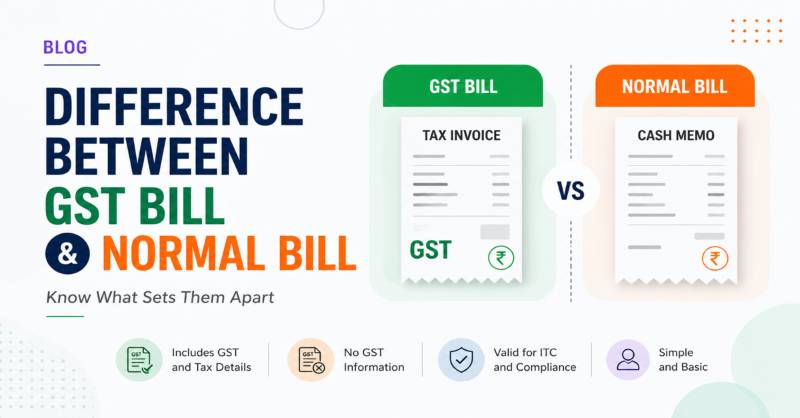
Billing is a basic part of any business, but many shop owners still get confused between a GST bill and a normal bill. At first glance, both may look similar—they show items, prices, and totals—but legally and practically, they are quite different.
Understanding this difference is important, especially if you are running a shop or planning to grow your business. It affects your taxes, compliance, and even how professional your business appears to customers.
💡 What is a GST Bill?
A GST bill, also known as a tax invoice, is issued by a business that is registered under GST. It includes not only the product or service details but also the tax charged under the Goods and Services Tax system.
A proper GST bill contains key details such as:
- GSTIN (GST Identification Number) of the seller
- Invoice number and date
- Customer details (in some cases)
- HSN/SAC codes for products or services
- Tax breakup like CGST, SGST, or IGST
- Total amount including tax
This type of bill is essential for businesses that need to file GST returns and claim input tax credit.
💡 What is a Normal Bill?
A normal bill is a simple invoice that shows the sale of goods or services without any GST details. It is commonly used by small businesses that are not registered under GST or those dealing in exempt goods.
A normal bill usually includes:
- Shop or business name
- Items sold
- Quantity and price
- Total amount
It does not include GST number, tax breakup, or compliance-related information.
⚖️ Key Difference Between GST Bill & Normal Bill
The main difference lies in tax and compliance.
A GST bill is a legally structured document used for tax purposes, while a normal bill is just a basic record of sale.
- A GST bill includes tax details; a normal bill does not.
- A GST bill is used for filing returns; a normal bill is not.
- A GST bill allows input tax credit; a normal bill does not.
- A GST bill is mandatory for registered businesses; a normal bill is optional and informal.
🧾 When Should You Use a GST Bill?
You must use a GST bill if:
- Your business is registered under GST
- You are selling taxable goods or services
- Your turnover exceeds the GST threshold limit
- Your customers need input tax credit
Using a GST bill ensures that your business remains compliant with tax laws and avoids penalties.
🧾 When is a Normal Bill Used?
A normal bill is suitable when:
- You are not registered under GST
- Your business turnover is below the GST limit
- You are dealing in tax-exempt products
- You run a very small shop or local business
However, as your business grows, relying only on normal bills can limit your operations.
📊 Practical Example
Imagine you sell a product worth ₹1000:
- In a GST bill, you might add 18% GST, making the total ₹1180. The bill will clearly show CGST and SGST or IGST.
- In a normal bill, you will simply charge ₹1000 (or include tax without showing it separately).
This difference becomes important when maintaining records or filing taxes.
📱 Why GST Billing is Becoming Important
With India moving towards a digital economy, GST billing is becoming more common. Customers, especially businesses, prefer GST invoices because they can claim tax benefits.
It also helps in:
- Maintaining transparency
- Building trust
- Managing accounts easily
Government regulations, guided by the Reserve Bank of India and GST authorities, are pushing businesses towards proper billing systems.
🚀 Role of Digital Billing Apps
Today, many shop owners are shifting to mobile billing apps to handle GST invoices easily.
These apps:
- Automatically calculate GST
- Generate professional invoices
- Store records securely
- Help during GST filing
This makes GST billing much simpler, even for beginners.
⚠️ Common Mistakes to Avoid
Many business owners make errors due to confusion between these two types of bills.
Some common mistakes include:
- Using a normal bill when GST is required
- Not mentioning GSTIN on invoices
- Incorrect tax calculation
- Mixing personal and business billing
Avoiding these mistakes is important to stay compliant and avoid penalties.
🏆 Which One is Better?
There is no “one better option”—it depends on your business.
- If you are a small, unregistered business → a normal bill may work
- If you are growing or GST-registered → GST bill is necessary
However, for long-term growth, GST billing is always the better choice.
💬 Conclusion
Understanding the difference between a GST bill and a normal bill is essential for running a smooth and compliant business. While a normal bill may be sufficient for very small setups, a GST bill provides structure, transparency, and legal compliance.
As businesses grow and digital systems become more common, adopting GST billing is a smart move. It not only helps with taxes but also builds trust and professionalism.
👉 In simple terms:
A normal bill records a sale, but a GST bill manages your business legally and financially.
