
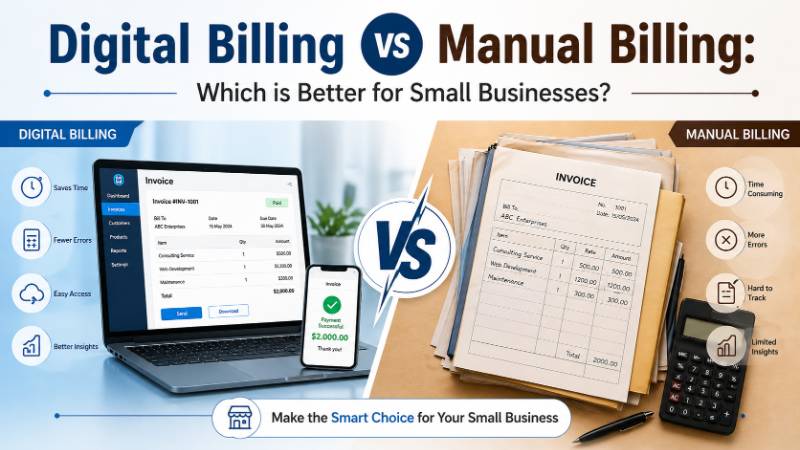
In today’s fast-changing business environment, billing is no longer just about creating invoices—it’s about speed, accuracy, and efficiency. Many small business in India still rely on traditional manual billing methods, while others are rapidly shifting towards digital billing systems.
So the big question is:
👉 Digital Billing vs Manual Billing – which is better for small businesses?
In this blog, we’ll compare both methods in detail and help you decide what’s best for your business.
💡 What is Manual Billing?
Manual billing is the traditional method of creating invoices using:
- Paper bill books
- Handwritten receipts
- Calculators
- Excel sheets
This method has been used for decades and is still common in small shops.
👉 It works fine for very small businesses with limited transactions.
💡 What is Digital Billing?
Digital billing uses software or mobile apps to create and manage invoices electronically.
It includes:
- GST billing apps
- POS systems
- Accounting software
These tools automate billing, calculations, and record-keeping.
⚖️ Digital Billing vs Manual Billing (Quick Comparison)
| Feature | Manual Billing | Digital Billing |
|---|---|---|
| Speed | Slow | Fast |
| Accuracy | Error-prone | Highly accurate |
| Record Keeping | Difficult | Easy & automatic |
| Cost | Low upfront | Low long-term |
| Scalability | Limited | High |
| GST Compliance | Difficult | आसान |
🚫 Problems with Manual Billing
Manual billing may look simple, but it comes with many hidden issues.
❌ Major Disadvantages:
- Time-consuming invoice creation
- High chances of calculation errors
- Difficult to track payments
- Risk of losing records
- No proper business insights
👉 As per reports, manual billing becomes inefficient as business grows and leads to slower operations and errors.
📱 Advantages of Digital Billing
Digital billing is designed to make business operations faster and smarter.
✅ Key Benefits:
⚡ 1. Faster Billing
- Create invoices in seconds
-
Reduce customer waiting time
👉 Digital systems allow instant invoice creation and sharing.
🎯 2. 100% Accurate Calculations
- Automatic GST calculation
- No manual errors
👉 This reduces financial losses and disputes.
📊 3. Easy Record Management
- All data stored digitally
- Easy search and access
👉 No more lost bills or messy registers.
💰 4. Better Payment Tracking
- Track pending payments
- Monitor cash flow
👉 Everything is updated in real time.
🧾 5. Professional Invoices
- Clean and branded bills
- Share via WhatsApp or email
👉 Improves customer trust.
📦 6. Inventory Integration
- Auto-update stock
- Avoid stock mismatch
👉 Helps in better business decisions.
💸 7. Cost Saving (Long Term)
- No paper or printing cost
- Saves time (which = money)
👉 Manual billing may seem cheap but has hidden costs like time loss and errors.
🧾 When is Manual Billing Still Useful?
Manual billing is not completely useless. It can still work in some cases:
✔️ Suitable for:
- Very small shops
- Low daily transactions (20–30 bills/day)
- No GST requirement
- Cash-only business
👉 Many small retailers still prefer manual methods due to simplicity and familiarity.
🚀 Why Small Businesses Are Switching to Digital Billing
India is moving towards a digital economy:
- UPI payments increasing
- GST compliance becoming strict
- Customers expect fast service
👉 Manual billing cannot keep up with these changes.
Digital billing helps businesses:
- Scale faster
- Reduce workload
- Improve efficiency
📊 Real Example (Simple Comparison)
Imagine you create 20 bills daily:
Manual Billing:
- 5–10 minutes per bill
- Total time: ~2–3 hours/day
Digital Billing:
- 10–20 seconds per bill
- Total time: ~10–15 minutes/day
👉 Huge time saving that you can use to grow your business.
⚠️ Challenges of Digital Billing
Digital billing also has a few challenges:
- Learning curve for beginners
- Requires smartphone or system
- Internet dependency (sometimes)
👉 But these are temporary and easy to overcome.
🏪 Which is Better for Small Business?
🏆 Final Verdict:
👉 Digital Billing is better for most small businesses
Because:
- Faster
- More accurate
- Scalable
- GST compliant
👉 Choose Manual Billing if:
- Your business is very small
- Transactions are limited
- You prefer simple methods
👉 Choose Digital Billing if:
- You want to grow your business
- You deal with GST
- You want better control & tracking
💡 Smart Business Tip
👉 Best strategy is:
- Start with digital billing early
- Train yourself or staff
- Use simple mobile apps
This gives you a long-term advantage.
🏆 Conclusion
The debate between digital billing and manual billing is no longer equal. While manual billing may still work for very small businesses, it limits growth, accuracy, and efficiency.
Digital billing, on the other hand, empowers businesses with speed, automation, and better control over finances.
👉 In 2026, going digital is not just an option—it’s a necessity.
