
A customer just disputed your payment.
Now what?
A chargeback is one of the most stressful things that can happen to a business owner. You delivered the goods. You did everything right. And now the money is being taken back. Here is exactly how it works — and how to stop it happening again.
A chargeback is not the same as a refund
Most business owners confuse a chargeback with a refund. They are completely different — and the difference matters enormously for your business.
A refund is when you decide to return a customer's money. You control it. You initiate it. There is no penalty fee involved.
A chargeback is when a customer bypasses you entirely and goes directly to their bank to dispute a payment. The bank investigates, often reverses the payment automatically, and charges you a dispute fee — regardless of whether the customer was right or wrong. You lose the money first. You have to fight to get it back.
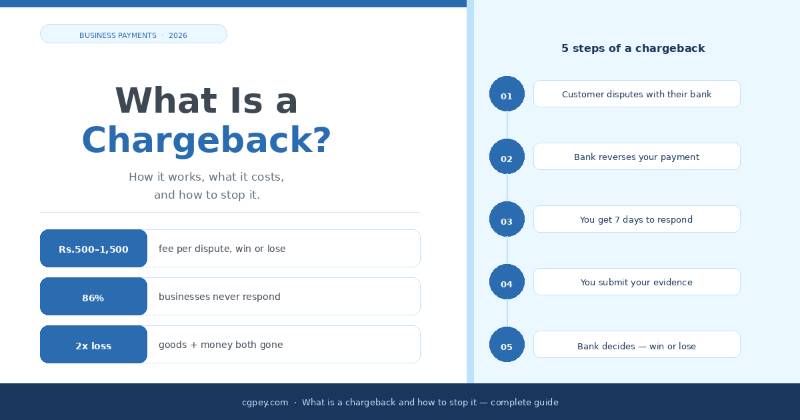
The double loss problem: If a chargeback goes against you, you lose the payment amount, you lose the goods or service already delivered, and you pay a chargeback fee of ₹500 to ₹1,500. That is three separate losses from one transaction.
The chargeback process — step by step
Customer contacts their bank
The customer calls or messages their bank claiming the payment was unauthorised, the goods never arrived, or the item was not as described. The bank opens a dispute case immediately.
Bank reverses the payment provisionally
In most cases the bank immediately reverses the payment from your account and credits it back to the customer while the investigation takes place. The money is gone before you even know about it.
You receive a chargeback notification
Your payment processor sends you a notification — usually by email — giving you 7 to 14 days to respond with evidence. Miss this window and you automatically lose the dispute.
You submit your evidence
You gather proof — delivery confirmation, order receipts, communication records, photos — and submit it to your processor. This is called representment. Only 14% of businesses ever do this step.
Bank makes a final decision
The bank reviews both sides and makes a ruling — usually within 30 to 60 days. If you win, the money is returned. If you lose, the reversal stands and the chargeback fee is deducted from your account.
Not all chargebacks are genuine — here are the 3 types
Stolen card used on your store
A fraudster uses someone else's card to buy from you. The real cardholder disputes it. You have almost no defence — the loss is yours unless you have strong fraud prevention tools.
Your business made a mistake
Wrong item delivered, duplicate charge, item not as described. These are legitimate chargebacks — the fastest resolution is to accept them, refund, and fix your process.
Customer disputes a genuine purchase
The most common type in 2026. A real customer receives goods but disputes the charge anyway — claiming they never received it or did not authorise it. This is the one you can fight and win.
Friendly fraud is now 70% of all chargebacks. Customers have learned that disputing a charge is easier than asking for a refund — and many banks side with the customer by default. Your best defence is documentation from the moment of purchase.
Can you handle this chargeback correctly?
7 ways to prevent chargebacks before they happen
- Use a clear business name on card statements. Most chargebacks happen because the customer does not recognise the charge. Make sure your trading name on statements matches what customers expect to see.
- Always get delivery confirmation with signature. For anything over ₹1,000, require a signed delivery receipt. A photo of the customer or their representative receiving the goods is even better.
- Send order confirmation emails immediately. An email trail showing the customer placed the order, received a confirmation, and accepted delivery terms is strong evidence in any dispute.
- Make your refund policy visible before purchase. Customers who know your refund policy are less likely to go directly to their bank. Put it on your website, invoice, and receipt.
- Respond to every complaint before it becomes a dispute. Most chargebacks start as a customer complaint that was ignored. A fast, friendly response to any complaint costs nothing and prevents a ₹1,500 chargeback fee.
- Use CVV and address verification for online payments. These tools flag suspicious transactions before they complete — stopping fraudulent purchases that would inevitably become chargebacks.
- Never ignore a chargeback notification. Eighty-six percent of businesses never respond to chargebacks — and automatically lose. Set up an alert so every chargeback notification reaches you within 24 hours and gets a response.
The golden rule: Document everything from the moment of purchase. Order details, customer communication, delivery proof, and payment records. If a chargeback ever arrives, your documentation is your entire defence — and it takes seconds to collect at the time but is impossible to recreate later.
BANNER IMAGE ALT TEXT & SEO
Short alt text: Blog banner showing a 5-step chargeback process flow — customer disputes, bank investigates, you get notified, decision made, you pay double loss — with the headline What is a chargeback and how do you stop it.
Full SEO alt text: Illustrated blog banner on a light grey background with a red top accent bar. Five white cards show the chargeback process step by step — Step 1 customer disputes in red, Step 2 bank investigates in amber, Step 3 you get notified in amber, Step 4 decision made in blue, and Step 5 if you lose showing refund amount plus chargeback fee plus goods already gone equals double loss with a ₹500 to ₹1,500 fee badge. The headline reads What is a chargeback and how do you stop it with a subtitle describing it as the complete guide for business owners.
Pinterest caption: 86% of businesses never respond to chargebacks — and automatically lose. A chargeback costs you the refund, the goods, AND a ₹1,500 fee. Here is how the whole process works and 7 ways to stop it before it starts. Save this.
Image filename: what-is-chargeback-business-guide-2026.png
Want more simple business payment guides?
No jargon — just the things every business owner needs to know.
